
You may already understand how gift cards improve cash flow, provide free revenue if not redeemed, and drive loyalty. Still, you might not be capturing and reconciling gift card transactions accurately to detect fraud and provide accurate financial statements. In this article, we will share our advice on accounting for gift cards in restaurants to ensure your financials are accurate and help detect fraud.
Accounting for Gift Card Journal Entries
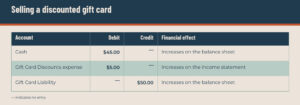
When a gift card is sold, the entire gross amount of the gift card is recorded as a liability. The gift card amount is recorded as a liability instead of as revenue because you are liable for providing goods or services later down the road, when the gift card is redeemed. The initial purchase of the gift card is not taxed (because the final purchase will be taxed), so the cash received and the liability recorded are equal. If the gift card is discounted or given away, then the entire gross amount of the gift card is recorded as a liability, the cash received (if any) is recorded as cash on your balance sheet, and the discount portion is recorded as a discount on your P&L.
Each table shows the debit and credit amounts for the example, along with how the entry affects your financial statements. A dash means there is no entry in that column.
Example: A $50 gift card is purchased from your restaurant,

Example: To incentivize future visits, your restaurant offers a 10% discount on gift card purchases – meaning that a customer can purchase a $50 gift card for $45. When a $50 gift card is purchased,
Example: A $50 gift card is given away by your restaurant to your 100th customer as a thank you for being a patron. When the gift is determined and granted,

When the gift card is redeemed, the liability is reduced by the redeemed amount, and the sale amount of the transaction is recognized as revenue.
Example: The $50 gift card above is gifted to a third person. The gift card is redeemed at your restaurant for a purchase of $29.99. When the gift card is redeemed,
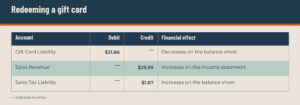
The $31.86 redemption includes the $29.99 purchase plus $1.87 sales tax, assuming a 6.25% sales tax rate.
All of these entries can be automated so they automatically post to your accounting system using MarginEdge or Restaurant365. Once you map the data points, you don’t need to touch it again unless a new POS data point is added.
Unredeemed Gift Card Accounting
As you know, not all gift cards are redeemed for their full amount, and some gift cards are not redeemed at all. Unredeemed gift card amounts are referred to as “breakage.” How you account for breakage may depend on whether or not you are required to follow Generally Accepted Accounting Principles (GAAP). If you are required to have an annual independent audit, you will typically be required to follow GAAP. If you do not have an annual independent audit, you have the flexibility to employ an alternative method that is more digestible by financial statement users. We’ll discuss both methods.
GAAP Method of Recognizing Breakage
Before 2019, breakage was recognized as a separate type of income only after the gift card’s redemption was considered “remote.” In most cases, this was after a gift card had an outstanding balance for two years or more. However, new (2019 and forward) GAAP revenue recognition standards require that breakage be recognized as income in proportion to actual redemption – which is, fortunately, typically sooner than redemption being deemed remote. This means that as gift cards are redeemed and actual sales are booked, a portion of the remaining outstanding gift card balance is also reduced from the liability account and recognized as income according to the determined breakage rate.
Example: Say that you have determined your restaurant has a breakage rate of 5%. As in the previous example, a gift card holder makes a purchase of $29.99, which yields $1.87 in sales tax. When the gift card is tendered as payment, the following will happen on your books:

The $31.86 redemption includes the $29.99 purchase plus $1.87 sales tax, assuming a 6.25% sales tax rate.
Breakage calculation: $29.99 sale × 5% breakage ÷ 95% expected redemption = $1.58.
The accounting entry above doesn’t need to be recorded at the transaction level, it can be recorded via a weekly or monthly journal entry. If you are using this method, we suggest maintaining a reconciliation sheet that reconciles your gift card liability balance on the books with the gift card liability balance shown in your POS system’s gift card liability or outstanding balance report. This will allow you to track and catch fraudulent gift card redemptions in the POS from period to period.
Alternate Method of Recognizing Breakage
If you do not have an annual independent GAAP audit requirement, you can explore an alternative to GAAP breakage recognition. Instead of estimating the breakage rate based on historical data and applying it to each gift card redemption, you can record the actual amount of breakage via an adjusting “true-up” journal entry each period, then reconcile the gift card balances in your POS directly with the Gift Card Liability on your books. This means you’ll manually evaluate the balances that should be “written off” and recognized as breakage by using a POS report to identify the open gift card balances that you no longer expect to be redeemed.
Most POS and gift card platforms offer a gift card balance report that lists open balances by card, which makes it easier to identify those balances and streamlines the process. This alternative method is easier to implement for the accountant and easier to understand by users of the financial statements. In order to implement this method, you will need a documented policy for when a balance is considered unlikely to be redeemed. Be aware that the federal CARD Act generally prohibits gift cards from expiring less than five years after issuance or last load, some states prohibit expiration entirely, and state unclaimed property laws may require unredeemed balances to be remitted to the state rather than recognized as breakage.
Example: You run your POS system’s gift card balance report at the end of the month, and see that your Gift Card Liability account includes unredeemed balances on cards that are more than 18 months old (the period after which your policy treats an unused balance as unlikely to be redeemed). Your accountant can record a journal entry to “write off” the $200 liability and recognize the revenue as breakage.

Gift Card Accounting for a Restaurant Group
Both methods explained above can be used in a restaurant group as well. Many POS systems can track instances where a gift card is purchased at one location but redeemed at another; confirm that yours reports these cross-location redemptions. You will record and reconcile gift card liabilities, revenue, and breakage by location using the same methods above. This applies whether the books for each location are separate or combined. In certain POS systems (like Toast), redemptions may exceed gift card sales at a given location thus resulting in a negative liability balance for that location if gift cards can be redeemed between locations. This is more likely to happen when adding a new location because the new location may not have enough gift card sales to cover the redemptions. This is fine, because the liability from another location will offset the redemption when consolidating the financials.
If each location is a separate legal entity, you must record an intercompany receivable and payable between the locations so each entity’s books reflect who owes whom. Accounting for gift cards in a franchise or restaurant group with independently owned units is a different process which is covered in Accounting for Gift Cards in a Restaurant Group.
How Is Gift Card Revenue Taxed for Income Tax Purposes?
How your gift card revenue is taxed depends on the accounting method used for tax purposes. If your accounting method on your tax return is cash basis, all of the proceeds from your gift card sales are taxed in the year you sell the gift cards. If your accounting method on your tax return is on an accrual basis, then the same principle applies unless you elect to defer it.
Under the deferral election, gift card sales are not taxed; only the amounts redeemed (plus any breakage recognized in your financial statements) are taxed in the year of redemption. However, if the entire amount of a gift card is not redeemed within a year, the remainder must be taxed in the next year and cannot be deferred beyond the end of the following tax year.
Example: In year 1, you sell $500 in gift cards, and elect to have the tax on those gift card sales deferred. During year 1, $300 of the gift cards are redeemed, leaving $200 outstanding. During year 2, $100 of the gift cards are redeemed, leaving $100 outstanding at the end of year 2.
- Year 1: $300 of redeemed gift card sales will be taxed.
- Year 2: entire remaining $200 of the $500 sold in year 1 is taxed as if the entire $200 were redeemed.
In order to report taxable gift card amounts accurately, you need to be able to track the remaining gift card balances by gift card sale year. Most POS systems offer a gift card balance report that shows the purchase date and remaining balance for each gift card; if yours does not, you will need to track this separately. This information can be provided to your tax accountant so they know how to adjust your taxable income.
Keep Your Gift Card Balances in Check
Gift cards can bring cash into your restaurant before a guest ever sits down, but the balance on your books still needs to reflect what you owe. Recording sales and redemptions correctly, documenting your approach to breakage, and reconciling your POS reports with your accounting system help you understand those balances and spot transactions that need a closer look.
For restaurant groups, that also means knowing which location sold the card and which location served the guest. Keeping those records accurate gives you a clearer view of each restaurant’s performance and the information your tax accountant needs at year-end.
At The Fork CPAs, we help restaurant operators connect their accounting and restaurant systems so they can trust their financials. Contact us to get your gift card accounting and reconciliation working properly.