
This is a Guest Article written by Mike Spitalney, CEO and founder of Everfund, a leading small business financing advisory firm. If you’d like to connect with Mike, you can inquire here or email him directly at mike@everfundcommercial.com.
A smarter way to think about restaurant startup costs
Opening a restaurant is exciting. You get the menu dialed in, you’re excited about the brand and you can almost hear the hum of a packed restaurant.
Then the contractor’s estimate lands in your inbox.
Suddenly the question gets less romantic and more mathematical: How much should I actually spend to build this thing? What do realistic restaurant startup costs actually include?
The answer isn’t “as little as possible.” And it isn’t “whatever it takes.”
The right answer lives at the intersection of revenue potential, profit margins, and risk tolerance. And when you understand that intersection, build-out decisions get a lot clearer. Restaurant startup costs must factor in all of the total investment required to open a restaurant, including construction, equipment, staffing, and working capital.
Here’s how experienced operators, lenders, and investors approach it.
How to estimate restaurant revenue before setting your build-out budget
Most first-time operators approach build-out like a construction problem. It’s actually a revenue problem.
Before you sign a lease or finalize plans, you need a credible answer to one question:
What can this location reasonably produce in annual revenue? Not best-case. Not Instagram-case. Real-case.
There are three common ways owners estimate it:
- Sales per square foot – typically at least $400–$600+ for fast casual and $300–$500+ for full service in established markets, with strong performers reaching higher
- Seat count × turns × average check
- Comparable restaurants nearby (or possibly a comparable unit you own)
Note – sales per square foot varies widely based on size and location. For more dense, urban locations – including New York and other major cities – these can be as much as 1.5-2.5x the above numbers. If estimating sales per square foot, be sure to gather local intel from other operators, brokers, or consultants.
Once you have a credible revenue number, you can think clearly about what level of investment it can support.
Investment-to-revenue ratio: how to budget your restaurant startup costs
One of the most useful metrics in restaurant startup budgets:
Total project cost ÷ projected annual revenue
If you project $3 million in annual revenue and your all-in build-out cost is $1.5 million, your ratio is 50%. Here’s how to read the ranges:
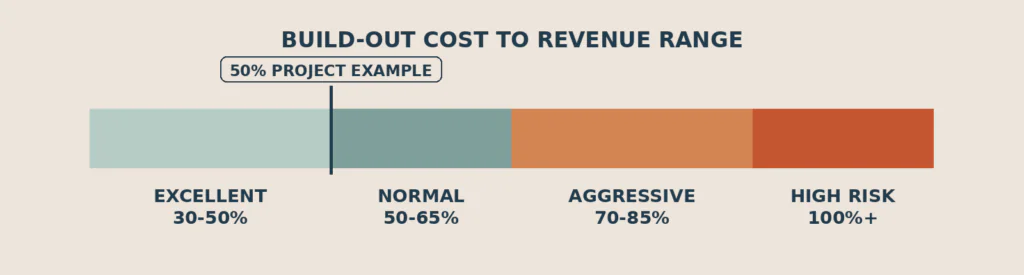
- 30–50% → excellent capital efficiency
- 50–65% → normal range
- 70–85% → aggressive but workable
- 100%+ → high risk
Using that $3 million example, the ideal total project cost lands somewhere between $900,000 (30%) and $1.95 million (65%). Spending $2.5 million to generate $3 million can still work, but there’s little room for error.
This ratio matters because it predicts how quickly the investment pays back.
What “Total Project Cost” actually means: The 9 key components of restaurant startup costs
When people say “build-out,” they usually mean construction. Lenders and experienced operators look at the full picture and factor in:
- Construction and tenant improvements
- Kitchen equipment
- Furniture, fixtures, and décor
- Architect and design fees
- Permits and impact fees
- Opening inventory and smallwares
- Pre-opening payroll and training
- Marketing and launch expenses
- Working capital cushion
Soft costs and opening capital commonly add 15–25% beyond the contractor’s estimate, so if construction comes in at $1.2 million, the true all-in cost is often $1.4–1.6 million by the time doors open. For reference, construction alone typically runs $150–$300/sq ft for second-generation space and $350–$700+/sq ft for a full shell build-out, with major metros like NYC pushing above those ranges.
But that number tells you almost nothing without the revenue context. Underestimating total cost is one of the most common early mistakes.
Understanding restaurant profit margins: How much profit can a restaurant actually produce?
The investment-to-revenue ratio matters because it reflects how quickly profit pays back the initial investment. For that, you need a realistic sense of margins.
Ultimately, these margins are heavily influenced by how well operators manage labor and food costs. Analyzing prime costs is a critical part of long-term profitability for restaurants.
Typical stabilized EBITDA margins (EBITDA → operating cash flow before debt and taxes):

- Fast casual: 12–18%
- Full service: 10–15%
- Bar-forward concepts: 15–25%
- Fine dining: volatile, can run higher or lower
With $3 million in revenue and a 15% EBITDA margin, you’re generating $450,000 in annual operating cash flow. That $450,000 has to cover loan payments, equipment replacement, growth, and ownership return. At a $1.5 million total investment, that’s a healthy relationship. At $3 million, the math tightens considerably.
The Payback Period: a quiet but powerful metric
Smart operators aren’t just asking “will this make money?” They’re asking: “How long until I get my money back?”
Payback period = Total investment ÷ annual owner cash flow
In restaurant economics, here’s how to think about payback periods:

- 2 – 3 years → excellent
- 3 – 5 years → solid
- 6+ years → risky
- No clear path → speculative
Debt extends this timeline, and since most new restaurants carry some, it’s worth factoring in early. Annual loan payments reduce the cash flow available to ownership, so your build-out budget and debt load need to be sized together. A $1.8 million project generating $450,000 in cash flow looks like a 4-year payback before financing. Add a $1 million SBA loan with roughly $120,000–$140,000 in annual debt service, and payback stretches to approximately 5–6 years.
The longer the runway, the more exposure you and your investors carry to shifts in prime costs such as labor and food costs also to changes in consumer behavior, and unpredictable economic cycles.
Debt is not the villain, but often the risk
Debt itself isn’t dangerous. Debt that requires everything to go right is dangerous.
The key metric is Debt Service Coverage Ratio (DSCR):
DSCR = EBITDA ÷ annual loan payments

What lenders (and smart operators) want to see:
- 1.5x or higher → strong
- 1.25x → acceptable minimum
- 1.0x → fragile
- Below 1.0x → structurally unsafe
If your projected EBITDA is $450,000 and annual loan payments are $300,000, your DSCR is 1.5x … reasonable. But ask yourself: what happens if revenue lands 20–30% below projection?
A well-structured deal can absorb underperformance. An overleveraged one typically cannot.
Why restaurants actually fail
Restaurants rarely fail because they cost too much in absolute terms. They fail because they cost too much relative to what the location can produce.
Here are some common build-out mistakes:
- Underestimating the total project cost. Budgeting for construction but not for equipment, or soft costs, or opening capital.
- Building for the concept they imagined rather than the market they’re entering. Over-investing in a build-out that the neighborhood’s price tolerance can’t support is a mismatch that no amount of great food fixes.
- Layout that fights the concept. Throughput, kitchen flow, and service efficiency get locked in at build-out. Mistakes there can cost money every shift.
- Skimping on working capital. Spending every available dollar on the physical build leaves nothing to absorb the gap between projected and actual early revenue. And the ramp to profitability can take longer than expected.
- Designing for ego rather than efficiency. Aesthetic decisions that don’t increase throughput, average check, or repeat visits can add cost without return.
The good news is that these are all knowable risks. A disciplined build-out process – one anchored in revenue reality from the start – sidesteps most of them before a dollar is spent.
Stress-Test before you commit
Before signing construction contracts, try running three versions of your financial model:
- Base Case — your realistic projections
- Conservative Case — 85% of projected revenue
- Downside Case — 70% of projected revenue
In each scenario, ask yourself: Does the debt still get paid? Is there positive cash flow? How much stress hits ownership, including your own salary, if you plan to draw one?
If the downside case collapses the business, the build-out model is too aggressive.
This kind of structured forecasting is a core part of professional restaurant financial modelling and is often where experienced operators lean on restaurant accounting support from specialists in the restaurant finance sector.
The Working Capital cushion
Even profitable restaurants experience uneven cash flow in year one. A typical ramp-up for a new restaurant can look like this:
- Months 1–3: negative
- Months 4–8: breakeven-ish
- Months 9–12: stabilizing
That’s not to say you can’t be profitable day one. Some restaurants are. But, without sufficient reserves, early volatility forces short-term borrowing or desperate decision-making.
Best advice here: keep 3- 6 months of operating expenses in the bank. It rarely feels necessary until it absolutely is.
The one question that ties it all together
Instead of asking “how cheaply can I build this?”, try: “what level of investment creates the best risk-adjusted return?”
Higher spend can be justified when it increases throughput, average check, operational efficiency, or the guest experience that drives repeat visits. Spending on elements that don’t move those levers rarely pays back.
And if you want to reduce the whole discussion to a single stress test, here you go:
If revenue comes in 25% below projection for 18 months, will the restaurant survive comfortably, limp along, or collapse?
Your answer to that question determines whether your build-out budget and debt load are wise, aggressive, or dangerous.
Closing Time
Opening a restaurant will always involve risk. It doesn’t have to involve blind risk.
When you anchor build-out decisions around revenue capacity, realistic margins, payback timelines, and conservative debt coverage, you turn a leap of faith into a calculated bet.
The restaurant operators who get this right combine disciplined financial planning with consistent monitoring of key metrics.
Calculated bets – even in restaurants – can be very good ones.
If you’re evaluating a project and considering borrowing to cover some of your build-out costs, reach out to Mike at mike@everfundcommercial.com or 703-801-5738. I’d be happy to talk through the numbers or begin the process of finding you the right lender.


