
Since 2018, restaurants have had the luxury of deducting 100% of their build-out expenses and other fixed asset purchases, such as equipment and furniture, by claiming bonus depreciation on their tax returns. Starting in 2023, this luxury was supposed to begin phasing out. Bonus depreciation was supposed to sunset to 80% in 2023, 60% in 2024, 40% in 2025, 20% in 2026, and 0% thereafter. However, the One Big Beautiful Bill Act (OBBBA), passed in 2025, changed all that and has once again brought back 100% bonus depreciation. In this article, we’ll walk you through the fundamentals of claiming bonus and Section 179 depreciation so you can maximize tax savings for your restaurant or bar.
Evolution and Fundamentals of Bonus Depreciation
Bonus depreciation is a temporary tax benefit introduced in 2002 as part of the federal Job Creation and Worker Assistance Act. It allows businesses to accelerate depreciation tax deductions on their fixed asset purchases in the year placed in service, rather than depreciating the asset over its useful life slowly. The accelerated percentage has varied over the years from 30% to 100% (see Table 1 here), and it was at its most beneficial stage after the passing of the Tax Cuts and Jobs Act (TCJA) in 2017, when it increased to 100% and liberalized the qualifying assets. It expanded the qualification of assets to include used assets and qualified leasehold improvements, whereas historically, it only applied to new assets and personal property (vs. real property/build-outs/improvements/etc.).
Like interest rates, bonus depreciation has been used as an economic stimulation tool over the last twenty years to control US business investment and labor markets. It expired in 2007 due to increased spending, was reactivated in 2009 through 2012 due to the 2008 crash, and continues to be active today.
The OBBBA restores 100% bonus depreciation for property acquired after January 19, 2025. Property acquired before January 20, 2025, remains subject to the phase-out schedule under the TCJA. Let’s break it down below:
Property acquired and placed in service after January 19, 2025: 100% bonus depreciation
Property acquired before January 20, 2025:
- Placed in service in 2025: 40% bonus depreciation
- Placed in service in 2026: 20% bonus depreciation
- Placed in service after 2026: 0% bonus depreciation
The property acquisition and placed-in-service dates are very important when claiming bonus depreciation. Many restaurateurs will try to justify a post-January 19 acquisition date, so let’s understand when a fixed asset is considered “acquired”. A fixed asset is considered acquired when a written binding contract for the acquisition of property is in effect. If a written binding contract for the acquisition of property is in effect before January 20, 2025, the property is not considered acquired after the date the contract is entered into. Consequently, property subject to a binding written contract entered into before January 20, 2025, is not eligible for the 100% rate and is subject to a 40% rate if placed in service in 2025, a 20% rate if placed in service in 2026, and a 0% rate if placed in service in 2027.
An Alternative to Bonus Depreciation
You might be wondering, if bonus depreciation was not always 100%, how did I write off 100% of my asset purchases in all those years? This brings us to another special business tax deduction widely used by restaurants– the Sec 179 deduction.
The Section 179 deduction allows businesses to deduct 100% of the purchase price of their qualifying fixed assets in the year placed in service up to a certain dollar limit. Section 179 is a permanent tax incentive dating back to 1958. It has an expensing limitation and a threshold at which the limitation begins to phase out. For 2025, the expense limitation is $2.5m. The 100% deduction begins to phase out on a dollar-for-dollar basis once your total fixed asset purchases for the year exceed $4m. The main differences between bonus depreciation and the Sec. 179 deduction are:
- The Sec. 179 deduction is limited to the taxable income of the business that is generating the deduction. This means that if the business that has placed the asset in service is experiencing a tax loss or break-even situation before the Section 179 deduction, the Section 179 deduction will be suspended and carried forward. In other words, bonus depreciation can generate or increase a taxable loss, but section 179 can only be claimed to the extent that the generating business has taxable income.
- The sec 179 deduction is limited to taxable income from all the taxpayer’s active trades or businesses. If the section 179 deduction has cleared the first limitation and can be claimed because the business has taxable income, it is also subject to a taxable income limitation at the owner/partner/shareholder level. The section 179 deduction is reported separately on a partner/shareholder’s K-1 and flows through to the partner/shareholder’s tax return, and is only allowed to the extent of their income from an active trade or business (this includes nonpassive business income, wages, gain/loss from the sale of business property, and rental income). Any unused amount in that year is carried forward to future years. This can be highly limiting and detrimental for mere investors in a restaurant. For example, if a restaurant generates a $200k profit before its $100k Section 179 deduction, a mere investor in that restaurant will only be able to claim the entire $100k Section 179 deduction if it has $100k of other non-passive business income or wages. On the other hand, bonus depreciation is allowed to generate a net operating loss (NOL) that can be applied toward other sources of income.
- Sec 179 can be applied on a property-by-property basis and for part of a property’s cost. Bonus depreciation automatically applies to all qualifying assets at their full costs minus any amounts expensed under Code Sec. 179. You can only opt out of bonus depreciation if you do it for all assets in the same asset class (such as all equipment placed in service for that year). With bonus depreciation, you can’t pick and choose what you want to bonus.
As you can see, bonus depreciation is advantageous because it allows you to generate a net operating loss for your business with few limitations for owners and partners. Section 179 merely offers the ability to zero out your income from that business, and even that can be limited to owner-operators instead of all owners/partners. However, Sec 179 can be advantageous because it provides more flexibility in picking and choosing depreciation per asset.
The Impact of the NOL Limitation and Excess Business Loss Rules
Before 2021, taxpayers could offset their other sources of taxable income using business losses fully; any unused losses could be carried back or forward to future years to offset taxable income. Since Section 179 cannot generate an NOL, bonus depreciation was preferred. However, starting in 2021, this is no longer the case. Business losses can only be claimed up to a certain amount each year ($313k for single filers and $626k for joint filers in 2025), and NOLs are limited to 80% of taxable income when carried over. Therefore, generating an NOL using bonus depreciation may be slightly less attractive than before. We demonstrate this in the next section. We discuss the Excess Business Loss and NOL limitations in a separate article.
Maximizing Depreciation Deductions for a Restaurant With No Investors
Now that you’re empowered with the fundamentals of bonus depreciation and Section 179 deduction, let’s demonstrate the optimal way to maximize tax savings for a restaurant owned by owner-operators, given the post-2021 NOL limitation and bonus depreciation phase-out.
Assume a restaurant opens in 2023 with a $1m investment in build-out and equipment, and the restaurant generates $200k profit each year before considering depreciation. The forecast below demonstrates that claiming bonus depreciation in 2023 is not the best approach because although a huge NOL is created in the year placed in service, the NOL is not entirely usable until 2029. Therefore, it’s more advantageous to opt out of the bonus and claim Section 179, which allows you to carry forward your Section 179 deduction and use 100% of it to offset business income for the first five years. Although the overall tax liability under both scenarios is the same, under Scenario 2, you are deferring tax payments to 2028.
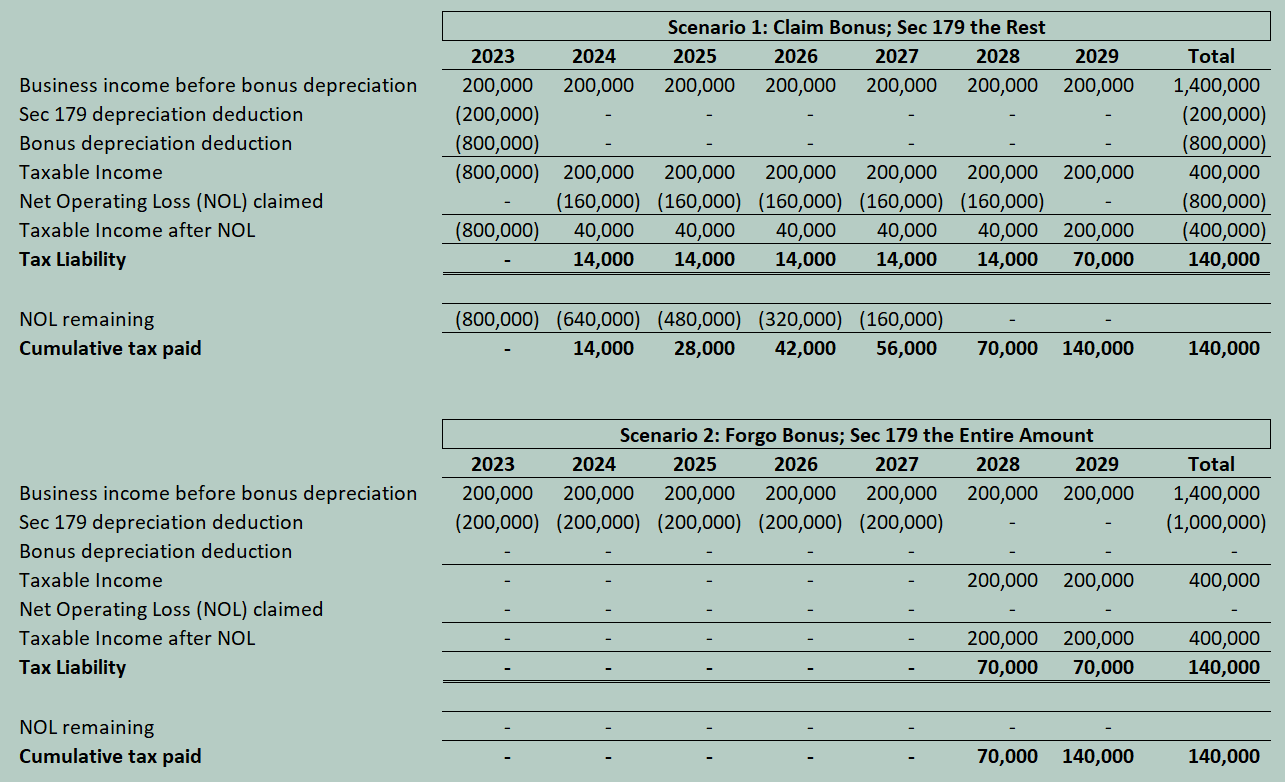
This example assumes the restaurant owner(s) are all actively involved in management, have no standard/itemized deductions or credits, no other income sources that the NOL could offset, and that state tax implications are neutral. However, it’s enough to demonstrate how to claim depreciation for owner-operators from 2023 onwards strategically. Most states don’t recognize bonus depreciation or the Sec. 179 deduction; therefore, they must be added back to taxable income. However, some states allow for one but not the other up to a certain dollar amount. State tax implications must be considered when deciding how to depreciate assets.
Maximizing Depreciation Deductions for a Restaurant with Investors
Maximizing depreciation deductions in a restaurant and bar with silent partners/investors requires a different (and simpler) strategy. As we discussed above, at the personal level, the section 179 deduction can only be claimed against nonpassive income (after it clears all other hurdles), such as wages and business income from an active trade or business. Therefore, you would need to know every one of your investors’ personal tax situations to understand whether they could benefit from the Section 179 deduction. This is impractical; therefore, we suggest claiming bonus depreciation instead of the Section 179 deduction unless the business is owned by a couple of partners/shareholders who are actively involved in operations, as shown above.
Claiming bonus depreciation might generate a tax loss for some partners/shareholders that surpasses the amount of taxable income they can offset from other sources under the excess business loss rules. However, it is impractical to plan around this since every partner has a different personal tax situation and income. It’s best to maximize bonus depreciation when available for businesses with multiple investors/silent partners.
Conclusion
100% Bonus depreciation has returned in 2025, but the NOL and excess business loss limitations are alive and permanent. You and your accountant must be wary of the implications and alternatives for claiming depreciation before doing what you have done in the past. Feel free to contact us to learn how you can strategically and proactively plan for taxes throughout the year by working with a complete financial solution- from bookkeeper to Controller with our restaurant tax services management.


